
The Accuracy Rate for AI in Streaming Media Discovery is < 50%. Minerva Has 97% Accuracy!
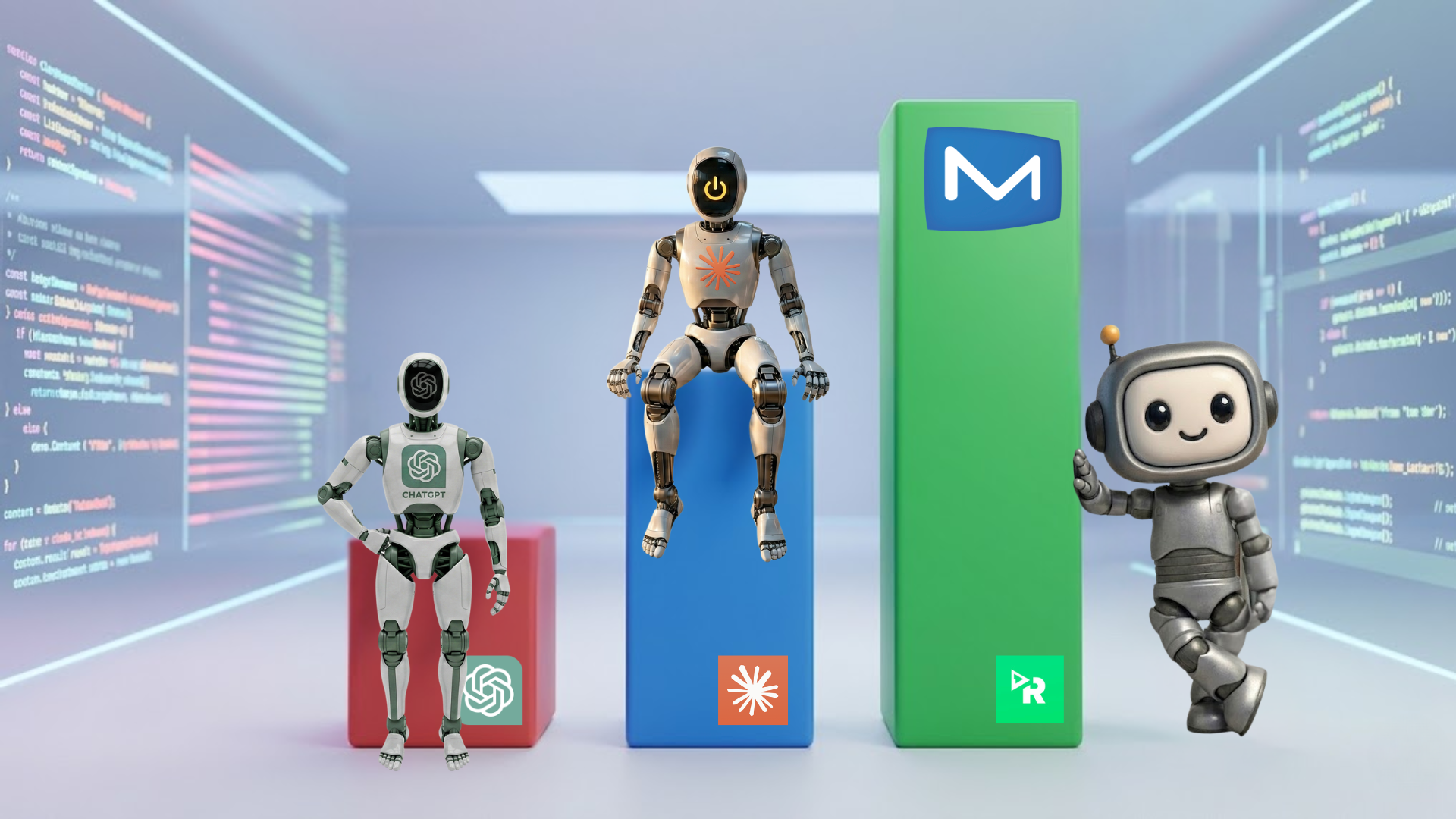
Imagine settling onto your couch after an exhausting day, asking your new smart assistant to find a specific movie, and discovering that the platform recommended has not carried that title for over a year. The modern streaming consumer faces an overwhelming volume of video content distributed across dozens of fragmented applications. For a brief moment, the industry believed that large language models would solve this navigation nightmare by acting as universal entertainment oracles. The reality, however, paints a much darker picture of technological maturity. Users are enthusiastically adopting intelligent assistants to find entertainment. They assume the machine possesses the correct answer. Yet the underlying data structures of most consumer artificial intelligence products are fundamentally ill-suited to the dynamic world of streaming rights and catalog changes. This article examines the critical reliability gap in digital media discovery, the startling inaccuracy of popular generative models, and how the partnership between Minerva Networks and Reelgood solves this exact problem through Minnie, our highly accurate digital companion. By combining domain-specific knowledge with deterministic programming interfaces, we can transform television navigation from a frustrating guessing game into a seamless viewer experience.
The Fragmentation of Video Entertainment
To understand why artificial intelligence struggles with media discovery, we must first understand the structural chaos of the modern television ecosystem. Ten years ago, the value proposition of streaming was simple aggregation. Today, the landscape has fractured into countless distinct walled gardens.
Here is a breakdown of the current video delivery models:
-
Subscription Video on Demand: Platforms requiring a monthly fee for catalog access. Users expect complete access without secondary transactions.
-
Transactional Video on Demand: Services where users rent or purchase individual titles on an ad hoc basis.
-
Ad-supported video on Demand: Free or subsidized services supported by commercial interruptions.
-
Free Ad-Supported Streaming Television: Linear channels delivered over the internet without a subscription fee.
The consumer journey is fundamentally broken. Users bounce between these distinct distribution models daily. Every platform functions as an isolated application. There is no universal remote control for the catalog itself. Finding a movie requires navigating through isolated applications, repeatedly entering search queries on clunky television keyboards, and hoping the title is included in the current subscription tier. This immense friction leads to subscriber churn, diminished viewing times, and extreme frustration. Viewers spend an average of twenty minutes simply deciding what to watch. The industry desperately requires an aggregation layer, which explains the massive excitement surrounding generative intelligence as a potential savior for content discovery.
The Broken Promise of General Intelligence
Large language models generate text based on statistical probabilities learned from vast internet archives. They do not access real-time databases natively unless specifically engineered to do so. In the realm of media availability, this structural limitation becomes a fatal flaw.
Entertainment news portals publish extensively when a major studio adds a blockbuster film to a streaming catalog. A flurry of articles will announce that a beloved comedy series is finally available on a specific platform. The language model ingests all these articles and forms a strong statistical association between the title and the platform.
Conversely, when that same film quietly expires and leaves the platform six months later due to licensing constraints, no press releases are issued. The artificial intelligence reads the arrival announcement but never hears the departure announcement. The training data and retrieval sources are completely biased toward new arrivals.
LLMs aren’t ready to be your content discovery layer, not even close.Marion Ranchet, Streaming Made Easy
When a user queries ChatGPT or Claude about where to watch a specific program, the system confidently regurgitates outdated information. It hallucinated the availability based on stale news articles rather than querying a live database. The consequences of these false positives are significant for service providers.
When an AI assistant tells a user a title is available on a service where it is not, or fails to list services where it is available, the downstream effects include user frustration, wasted clicks, and erosion of trust in the platform.David Markowitz, Digital Entertainment Group
The Empirical Evidence of Artificial Inaccuracy
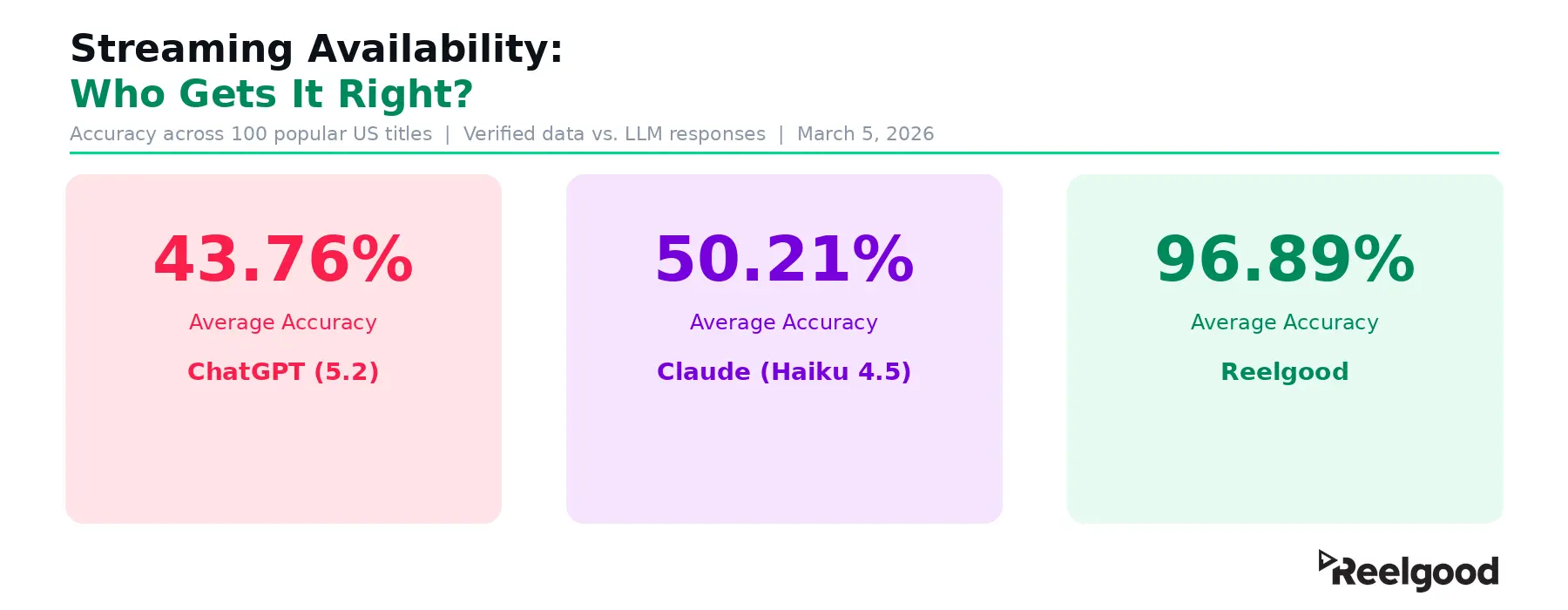
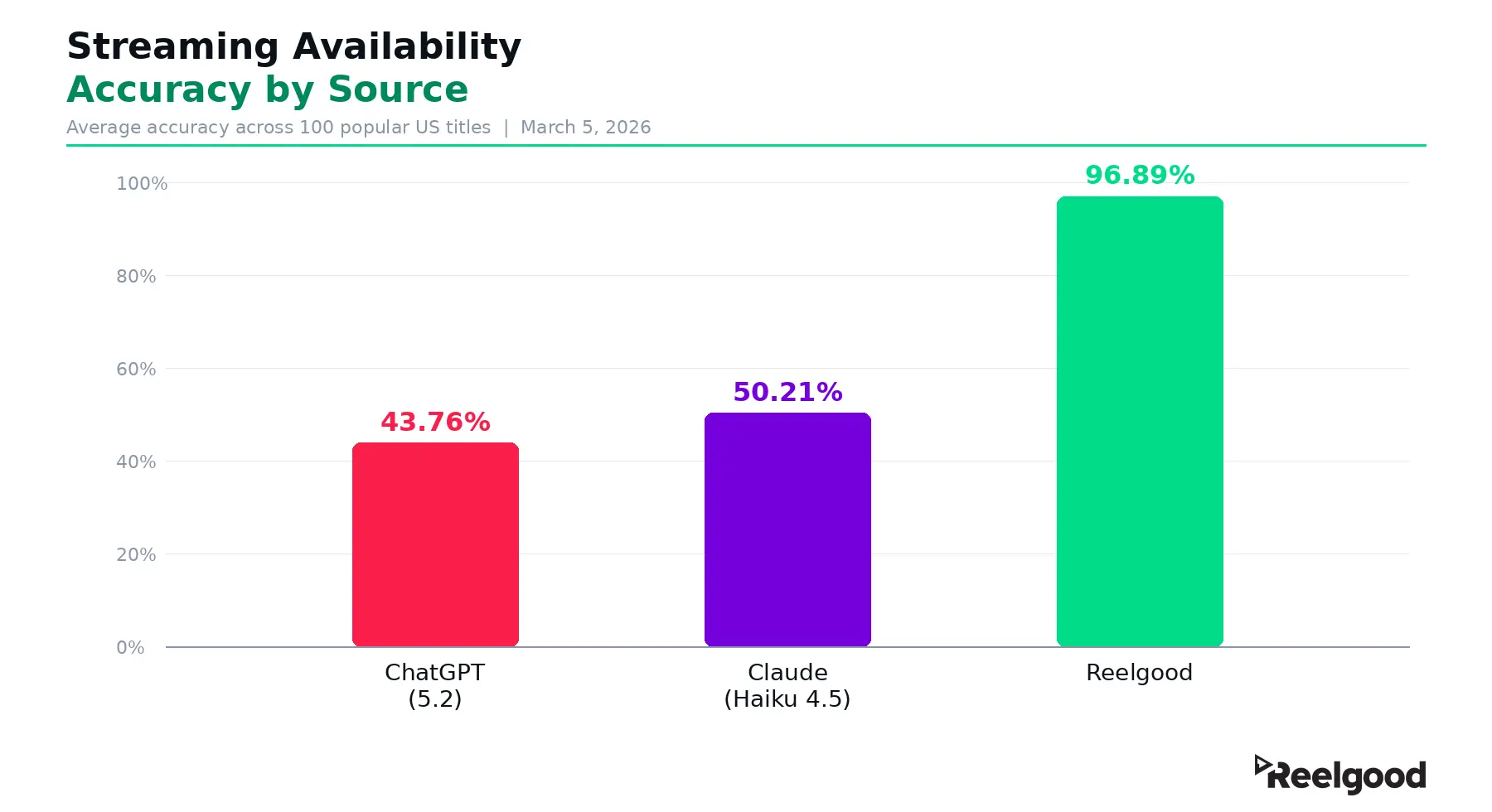
We do not have to rely on anecdotal frustration to prove this point. Rigorous empirical analysis provides definitive proof of this technological shortfall. Reelgood conducted a comprehensive, controlled study examining the reliability of various generative models across 100 popular television shows and movies in the United States market.
The methodology involved prompting different systems with the exact same request for streaming availability and meticulously comparing the generated answers against verified manual checks of the streaming platforms. The results are incredibly striking and serve as a stark warning for the media industry.
Half the time users ask an LLM where to watch something, they’re directed to a service that no longer has the title, or miss a service that does have it availableReelgood accuracy Analysis.
ChatGPT scored a mere 43% in overall accuracy. Claude performed only slightly better, scoring just above fifty percent. These figures essentially represent the success rate of a coin toss. A system that is wrong half the time cannot serve as the primary interface for consumer video consumption.
By stark contrast, the domain-specific infrastructure managed by Reelgood delivered near perfection.
Reelgood’s data correctly identified streaming service availability nearly twice as often as Claude and more than twice as often as ChatGPT.Reelgood accuracy Analysis
These massive errors are not random anomalies or temporary glitches. They follow highly predictable patterns that expose the structural failures of the underlying architecture. The models suffer from severe blindness to transactional availability. They frequently misunderstand complex bundling agreements in which a service is an add-on to a broader subscription. Furthermore, they struggle with basic title disambiguation when multiple films share the same name or when properties undergo international rebranding.
The Anatomy of Streaming Data Failures
To appreciate the superiority of a deterministic data pipeline, we must examine exactly why the generalist models fail so spectacularly. The entity resolution problem is perhaps the most difficult technical hurdle in the entertainment sector. Every streaming service uses its own internal content identification system. There is no universally adopted global key that seamlessly joins catalogs across different platforms.
Simple title matching fails constantly. Multiple distinct movies share the exact same title. A classic film from the nineteen eighties might share a name with a modern remake, but only one is available for streaming. Additionally, the same piece of content is often listed under slightly different titles across services due to regional naming conventions, translation variations, or corporate rebranding.
Matching based on metadata is equally unreliable. Fields that an engineer might expect to be completely consistent, such as the original release year and the total runtime, vary more often than they agree. One platform may list a film’s theatrical release year, while a competing platform uses its streaming premiere date as the primary timestamp. Runtimes differ depending on whether international credits, localized introductions, or studio bumpers are included in the video file.
Resolving these disparate catalogs into a single, unified, and perfectly accurate view of what is available requires specialized, domain-specific infrastructure. It requires a dedicated team to map identifiers and verify anomalies daily. A generic neural network simply guessing the next word in a sentence is mathematically incapable of performing this intricate catalog mapping.
Minerva Networks, Reelgood, and the Minnie Advantage
This brings us to our proprietary solution: Minnie.
Generalist AI treats media availability as a statistical guessing game, but in the living room, being wrong half the time is a broken promise to the viewer. With Minnie, Minerva has bridged the gap between generative artificial intelligence and deterministic data. We deliver 97% accuracy because operators don’t just need a conversational interface. They need a precise, authoritative guide that ensures subscribers can seamlessly watch what they want, without the frustration of digital dead ends.Mauro Bonomi, CEO of Minerva Networks
Minnie is the intelligent digital assistant developed specifically by Minerva Networks for the television ecosystem. Minnie is not a generic cartoon character, but rather a carefully designed mascot that serves as a reliable, authoritative guide for the viewer.
Minnie is fundamentally different from a generic language model prone to frustrating hallucinations. Minnie operates as an agentic interface deeply integrated with authoritative, real-time data sources. When a user asks Minnie for a movie recommendation or searches for a specific television show, Minnie does not guess based on internet articles from two years ago. Instead, Minnie directly queries the robust Reelgood application programming interface.
Because Minnie leverages this specialized proprietary data infrastructure, the recommendations provided by our assistant are an astounding 97% accurate. This is a monumental leap from the fifty percent accuracy of standard models. Minnie guarantees that the recommended content is currently available to the viewer on their specific connected device and within their specific geographic region. The visual representation of our technology, the Minnie mascot, stands as a symbol of precision and absolute trust in a chaotic sea of algorithmic confusion.
The Operator Perspective and Business Implications
For broadband operators, telecommunications providers, and independent media companies, the stakes involved in content discovery are absolutely enormous. These companies are fighting a daily battle for customer retention and engagement. A clunky interface that provides false information actively drives subscribers away and pushes them toward competing platforms.
If an operator decides to deploy a generic chat interface to help users find content, they are making a grave strategic error. They are actively degrading the user experience. Sending customers on a digital wild goose chase for movies that do not exist on the promised platforms instantly destroys brand loyalty.
Marion Ranchet highlights this critical dynamic beautifully in her recent post. She notes: “As AI assistants position themselves as the front door for content discovery, it’s crucial to remember that, like everything, they’re only as good as the data they learn from.”
As AI assistants position themselves as the front door for content discovery, it’s crucial to remember that, like everything, they’re only as good as the data they learn from.
Marion Ranchet, Streaming Made Easy
Operators must adopt purpose-built tools that respect the complexity of media licensing. The powerful combination of the Minerva Networks platform and the Reelgood data engine provides the ultimate competitive advantage in the modern market. By surfacing relevant content with 97% accuracy, operators completely eliminate the massive friction of discovery. This precision keeps the viewer engaged inside the operator ecosystem, driving higher consumption metrics and lower monthly churn rates. It is an investment in consumer trust.
The Future of Agentic Media Interfaces
We are rapidly moving beyond simple text-based answers and entering the era of agentic workflows. The future of television belongs to autonomous agents that act on behalf of the user with total reliability. An agentic interface does not merely tell you where a movie is located. An agentic interface finds the correct movie, verifies your current subscription status, confirms the geographical licensing rights, switches the television input if necessary, and initiates the playback automatically without requiring a single click from the viewer.
This level of seamless automation demands perfect underlying data. Fifty percent accuracy is a catastrophic failure in an automated workflow. If an agent automatically launches an application only to present the user with a purchase screen for a movie they thought was free, the user will permanently disable the agent. 97% accuracy, however, enables true autonomous operation. It allows the technology to fade into the background, leaving only the pure enjoyment of the entertainment itself. Minerva Networks is building this exact future today.
Conclusion and Strategic Call to Action
The global entertainment landscape will only become more fragmented and complex in the coming years. Major studios will continue to launch and shutter their own streaming applications. International licensing agreements will continuously shift valuable content across borders and between competing platforms. Navigating this chaotic environment requires specialized technology and meticulously verified data.
Generic intelligence cannot replace deep domain expertise. The glaring fifty percent failure rate of general models proves that media discovery requires dedicated infrastructure. We invite broadband operators, telecommunications providers, and service platforms to discover a vastly superior approach to video navigation.
We encourage you to explore the advanced capabilities of the Minerva Networks platform. Meet our intelligent assistant, Minnie, learn about our powerful integration with Reelgood data, and see firsthand how perfectly reliable data transforms the consumer television experience. Dig deeper into our technical offerings and discover how Minerva Networks can elevate your media business today.
Sources Consulted
- LinkedIn, Marion Ranchet, LLMs Aren’t Ready To Be Your Content Discovery Layer
- Reelgood Website, Reelgood Homepage
- Reelgood Data, Streaming Availability Data Precision Analysis
- Forbes, Rick Ellis, ChatGPT And Claude Score Below 51 Percent Accuracy On Streaming Availability
- DEG Online, David Markowitz, ChatGPT and Claude Score Below 51 Percent Accuracy on Streaming Availability Queries
- MediaPost, Reelgood End of Year Report