
BroadcastPro Middle East Summit 2026: What MENA’s Shift from Growth to Profitability Means for Operators
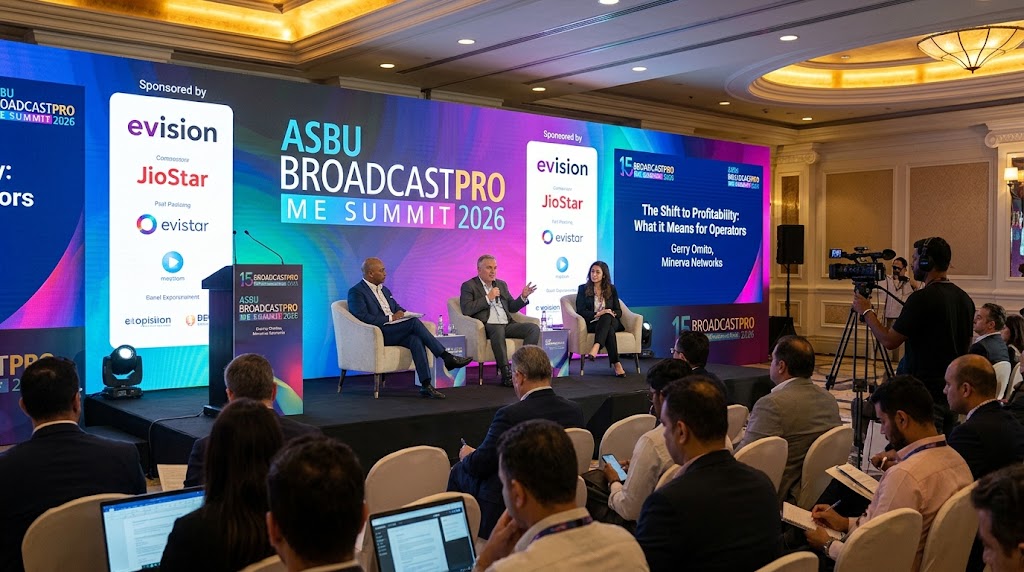
Guest post by our Worldwide Director of Sales Engineering, Gerry Ornito.
The MENA media market has stopped chasing subscribers at any cost. At this week’s BroadcastPro Middle East Summit in Dubai, operators, streamers, and technology leaders described their next phase: sustainable monetization, hybrid architectures, and AI that pays for itself.
The summit backed up what we said at IBC 2026. The era of speculative tech hype and expensive direct-to-consumer (DTC) land grabs is over. The market leaders are now organizing around four priorities:
- Intelligent Super Aggregation: bundling and partnerships that lower acquisition costs and reduce churn
- Agentic AI Automation: AI agents that run whole workflows, not just one-off generative tools
- Cloud-Native Hybrid Operations: putting each workload where it performs best and costs least
- Grassroots Sports and IP Building: owning rights for the long term instead of leasing them
Below are the highlights from each session and what they mean for pay-TV operators, telcos, and streaming platforms in the region.
Key Takeaways at a Glance
- Nearly 60% of MENA platforms already run two or more business models (SVOD, AVOD, TVOD). Multi-tier monetization is now the norm.
- AI productivity gains of about 20% come from redesigning workflows, not from adding AI on top of old ones.
- Hybrid cloud is the default architecture. Latency-critical work stays on-premises, while archives, disaster recovery (DR), and monetization move to the cloud.
- Original sports IP takes a horizon of 10 years or more. Free reach at the top of the funnel feeds paid tiers lower down.
Session 1: The Streaming Dilemma: Growth, Profitability, and Survival
Panelists: Yan (Ipsos, moderator), Sunil (StarzPlay), Mohammed (OSN+), Richard (Smashi), Samer (VIU)
Regional platforms are evolving, not just surviving
Local MENA platforms have a structural advantage over global players: they know the region’s content, culture, and languages. They are using that advantage to adapt their business models rather than just defend market share.
Hybrid monetization is now standard
The session’s market data shows how common multi-model monetization has become:
| Business model | Share of platforms |
|---|---|
| SVOD (subscription) | 78% |
| TVOD (transactional) | 70% |
| AVOD (ad-supported) | 66% |
| Hybrid (two or more models) | ~60% |
How the region’s leading platforms compete
- StarzPlay named piracy as its main competitor. It runs a multi-model mix (SVOD, TVOD, AVOD, and ad-supported SVOD) so it can earn revenue across income segments. Sports rights such as Serie A, UFC, and cricket bring in new subscribers, and entertainment content keeps them. Its recent partnership with JioHotstar for cricket distribution follows the same approach.
- OSN+ focuses on premium tiers and content velocity, aiming for 52 weeks of fresh releases built around HBO and other core studio IP. Targeted ad-supported tiers widen the acquisition funnel without cannibalizing high-value subscriptions. The panel also explained why a proposed OSN+/Anghami merger was set aside: video and music need different user experiences.
- Smashi earns most of its revenue from branded and sponsored content. It uses niche live sports, more than 40 regional leagues, to convert viewers to SVOD. Its view was that at smaller scale, FAST and CTV ad revenue alone cannot cover rights and technology costs.
- VIU runs a two-layer funnel. A free tier brings in viewers and earns ad revenue right away, and those viewers convert to SVOD over time. Its core content pillars are Arabic (with sharp spikes during Ramadan), Turkish, and dubbed Korean and Chinese titles.
What it means for operators
- Platform agility is essential. MENA platforms now need multi-tier entitlements (SVOD, AVOD, and FAST in one service) to reach the region’s different viewer segments.
- Super aggregation lowers CAC and churn. Streamers depend on telco B2B bundles, banking perks, and partnerships between platforms, such as OSN+ with Disney+ and StarzPlay with JioHotstar. Operators that can aggregate these services into a single experience become essential distribution partners.
Session 2: From Experiment to Enterprise: Making AI Pay
Panelists: Dipesh (moderator), Dominic (baillie.ai), Fadi (SRMG), Maysam (Yasmina & Yango Play)
Redesign beats “lift-and-shift”
Adding AI to legacy operations does not produce real ROI. The large efficiency gains come from rebuilding workflows from scratch around autonomous AI agents.
Rethinking how AI ROI is measured
CapEx and OpEx savings matter less than the time freed up for creative and strategic work. Panelists reported baseline productivity gains of around 20%.
Hybrid teams and multi-model strategies
Organizations are building hybrid departments where human staff work alongside named AI agents. To avoid vendor lock-in and keep costs down, they route tasks across multiple AI models instead of relying on a single LLM provider.
Governance is non-negotiable
The main enterprise risks identified were:
- Uncontrolled token spend
- Prompt injection attacks
- Data privacy leaks from unvetted open-source models
Good governance requires managed token budgets and secure internal execution environments.
What it means for operators
AI in media is moving from generative tools that produce text and images to agentic automation: orchestrating work across content metadata, dynamic ad insertion, and automated localization. The operators that benefit most will be those whose platforms expose clean data and open APIs that agents can work with.
Session 3: Rebuilding the Broadcast Stack: What CTOs Must Prioritize Now
Panelists: Dipesh (moderator), Amir (AI Media Lab), Eyad (stc), Faraz (StarzPlay), Shabbir (CNBC Arabia), Suhail (IMI)
Cloud works, with caveats
Cloud processing for media works well, but public cloud does not support standard IP multicast. Teams use transport protocols such as SRT and REST APIs between virtual machines instead. The target starting latency is 6–7 seconds, with further optimization after that.
The hybrid split CTOs are converging on
| Stays on-premises | Moves to the cloud |
|---|---|
| High-speed daily newsroom retrieval | Archives |
| Immediate editorial cutting | Disaster recovery (DR) |
| Primary in-memory processing | Monetization and dynamic packaging |
Controlling cost and lock-in
Egress charges are still a major cost. Operators manage them with dedicated Direct Connect links, private telco networks, and standard (“vanilla”) Kubernetes deployments that keep workloads portable and operating costs predictable.
Results at scale
One regional telco reworked its CapEx/OpEx model and delivered 700 live channels and 35,000 hours of content to 70% of its target audience in just three months.
A media publisher reported a 58% increase in ad impressions after modernizing its web infrastructure and applying targeted AI.
What it means for operators
CTOs want open, flexible platforms that avoid proprietary cloud lock-in and still deliver low latency for high-concurrency live events. Cloud-native, portable architecture is now a basic requirement.
Session 4: The New Sports Agenda: Rights, Reach, and Revenue
Panelists: Joe (moderator), Adil (Sports Spirit Federation), Alessandro (Aspire / A2RL)
Leased rights vs. owned IP
Tier-1 sports rights are expensive, leased assets controlled by a small number of powerful rights holders. Lasting value comes from building regional grassroots IP with perpetual rights, such as the UAE’s homegrown Soccer 60 or regional motorsport like A2RL.
The limits of standalone sports DTC
Standalone sports apps cause subscription fatigue and split audience attention. The panel recommended hybrid distribution instead:
Top of the funnel: social media (9:16 vertical video) and free-to-air (FTA) broadcasts for reach
Bottom of the funnel: moving dedicated fans into SVOD and pay-per-view (PPV) tiers
Patience pays
Building profitable original sports IP takes at least 10 years. Promises of a three-year payback are not realistic.
What it means for operators
Sports rights eat into general media budgets, so live events have to do more. Operators should pair live feeds with interactive features, fast catch-up tools, and targeted monetization to increase subscriber lifetime value.
The Bottom Line: Profitability Is the New Growth Metric
Across all four sessions, the message was the same. MENA’s media leaders are trading market-share races for disciplined, sustainable monetization. In practice, that means:
- Aggregating content and partners into one unified experience
- Monetizing across SVOD, AVOD, TVOD, and FAST tiers within a single service
- Automating operations with governed, agentic AI
- Deploying on open, cloud-native, hybrid infrastructure that avoids lock-in
These are the same priorities behind Minerva’s approach to video delivery: helping operators and service providers launch, aggregate, and monetize TV and streaming services with agility and control over costs.
Want to explore how your platform can turn these trends into revenue?